
01 / COMFORT
When someone else gets uncomfortable
Do you soften your words, reassure them, change the subject, or take responsibility for feelings that aren't yours to manage?
You know racism is real. You know your values. What happens when acting on them means risking your comfort, your reputation, or your place in the room? GOOD WHITE PEOPLE is where we practice finding out.
Four weeks of live group practice · Small cohorts · Individualized developmental feedback
Put down $150 by the deadline. Choose an eligible 2027 cohort through October.
For one four-week cohort.
A difference of $1,000.
Credited toward your total tuition.
GOOD WHITE PEOPLE is a four-week, small-group experience designed for white people who recognize racism and want to examine how whiteness operates in their own relationships, decisions, and group behavior.
It's a live practice. The group itself becomes part of the learning. When someone goes quiet, tries to rescue another person, asks who's in charge, or rushes to make the room feel better, we can examine what's happening while it's happening.
Under the guidance of Dr. June Cara Christian, you'll investigate your relationship to authority, belonging, discomfort, and accountability. You'll practice responding without needing a perfect script or a guarantee that everyone will approve.
You don't need to arrive with flawless language or all the answers. You do need to be willing to participate, examine your impact, and stay engaged when the work gets uncomfortable.
This isn't another opportunity to agree that racism is wrong. It's an opportunity to notice what you actually do when something important is at stake.
Do you soften your words, reassure them, change the subject, or take responsibility for feelings that aren't yours to manage?
Who gets to define what's appropriate, whose judgment counts, and what happens when the group doesn't agree on the rules?
What changes when your relationship, reputation, access, or desire to be liked enters the decision to act?
Four facilitated Wednesday sessions and weekly Sunday peer practice create repeated opportunities to notice your responses, try something different, and learn from what happens. Individual assessments and reflection materials make your development visible.
Explore your relationship to power, the cost of silence, and the expectations you bring into the room.
Study emerging patterns of authority, comfort, avoidance, and the pressure to behave correctly.
Observe the feelings and assumptions that shape your decisions during uncomfortable exchanges.
Use feedback and reflection to identify the practices that need your continued attention.
The precise content of each session emerges from the group's live experience; this is an overview of the developmental arc, not a fixed weekly script.
Someone laughs nervously. Someone redirects. Someone waits for the person with the most authority to speak. You sense the shift in the room, and you feel your own urge to do something—or nothing.
There may be several reasonable ways to respond. The point is to examine the choice you're making and the conditions shaping it.
“What am I protecting? Whose comfort am I managing? What authority am I waiting for? What could I do next?”
GOOD WHITE PEOPLE helps you make these questions available before the moment has already passed.
What you believe. What you do. What you protect. What you can change.
You'll work with developmental assessments, structured reflections, and individualized interpretation that help connect your values to your observable patterns. These aren't diagnoses or moral grades. They're tools for better awareness, more intentional action, and continued practice.
Explore your access, credibility, belonging, exposure to consequences, and institutional fluency. The profile makes your relationship to power more specific than a label like privileged or marginalized.
View sample PDF ↗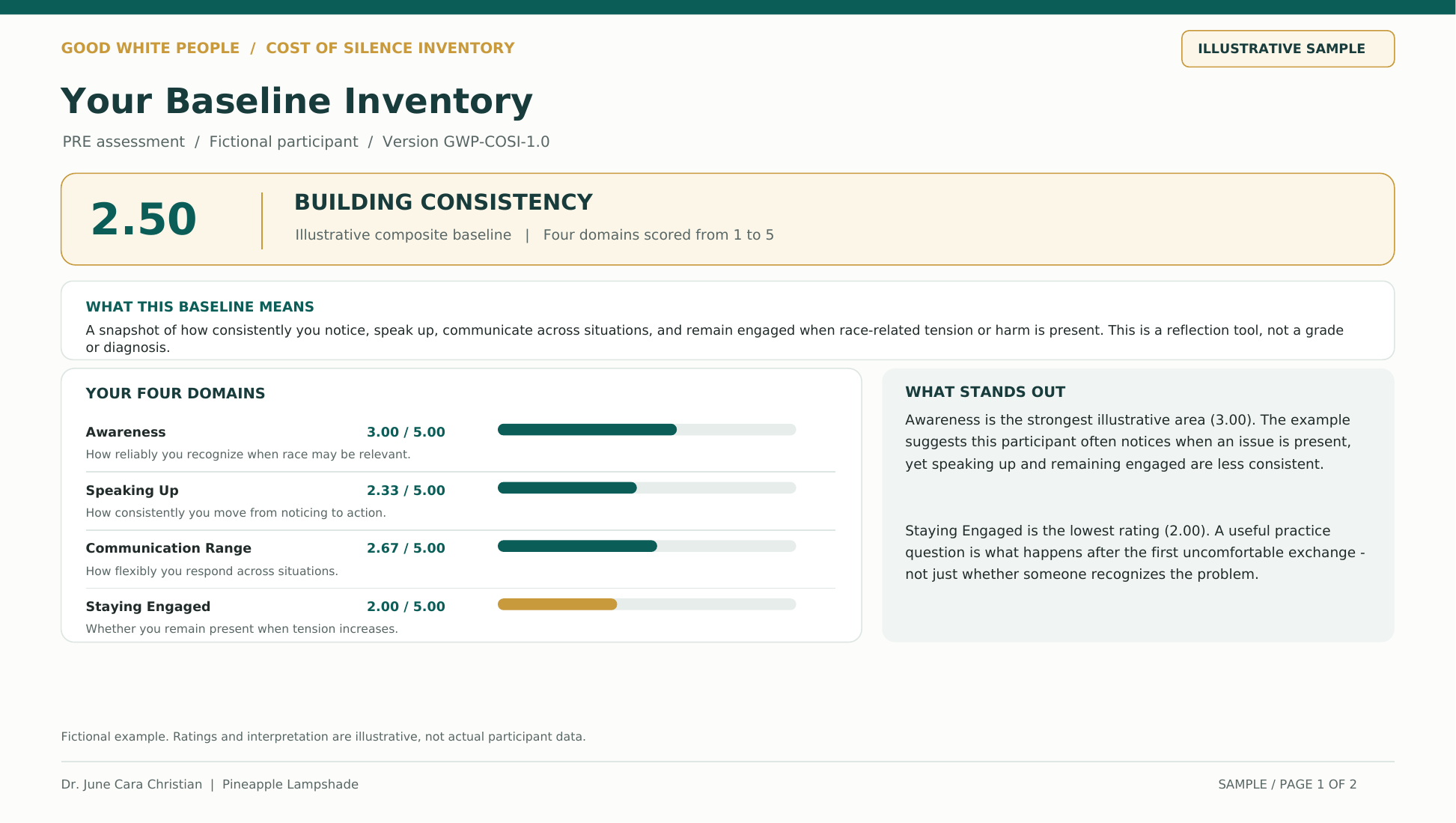
Examine four practices: awareness, speaking up, communication range, and staying engaged. Compare your own ratings over time to identify movement and unfinished work.
View sample PDF ↗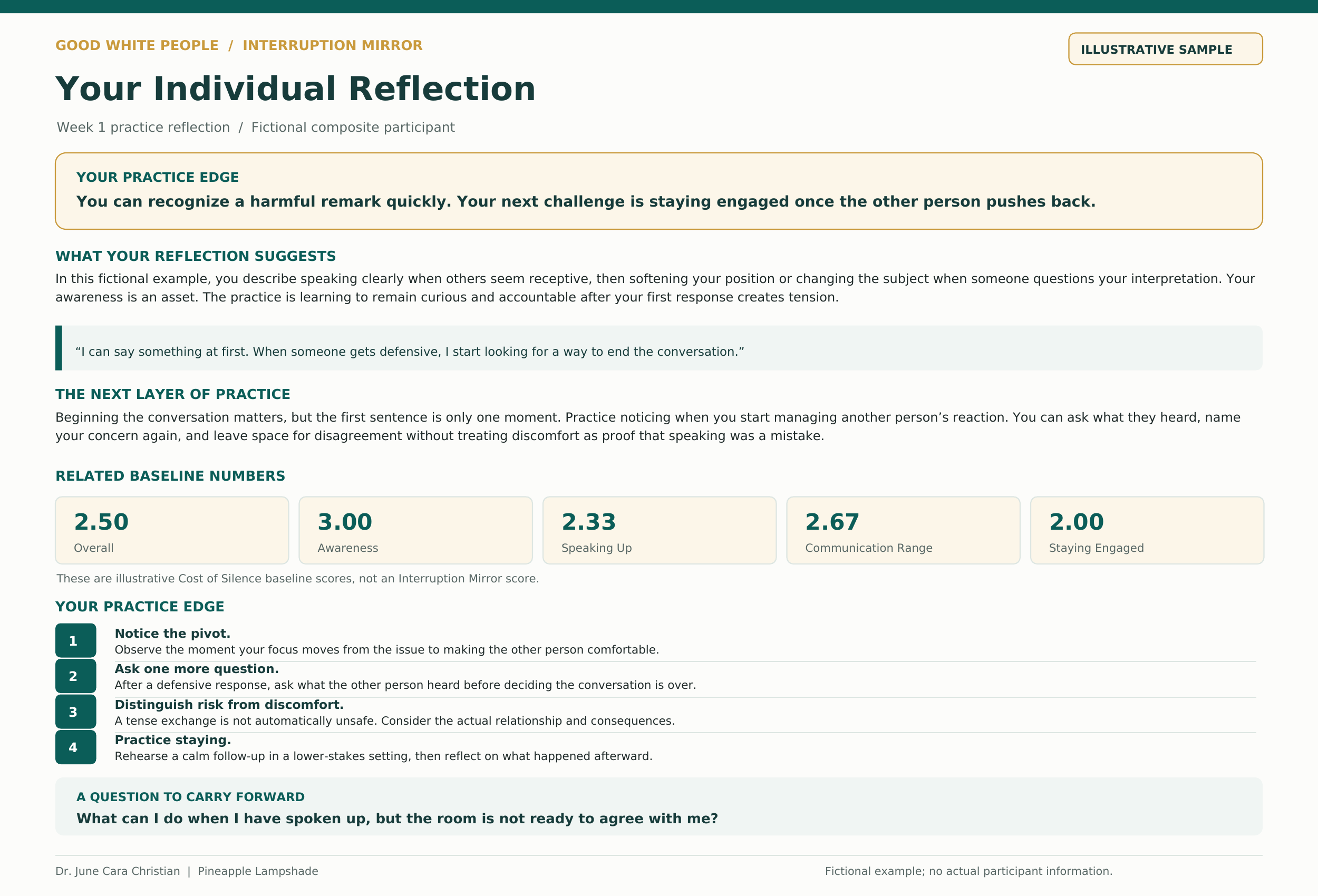
See how your willingness to speak can shift depending on relationships, context, authority, or anticipated consequences—and where to practice next.
View sample PDF ↗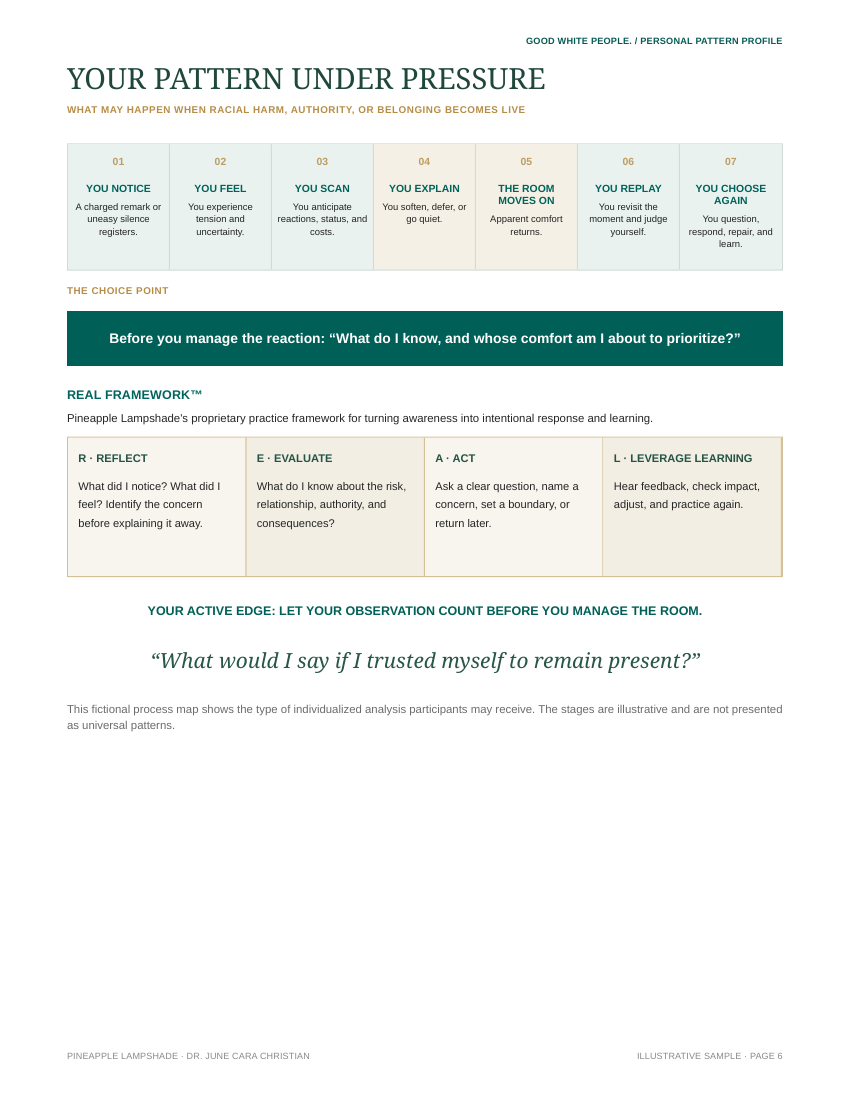
Receive a written synthesis connecting observations, assessments, cases, and reflections, with developmental insights and practical areas for continued work. The depth and length vary with the individual.
View sample PDF ↗ View narrative page ↗Sample materials use fictionalized or illustrative participant information. Actual assessments and written feedback are individualized. Personal histories and identifying details of past participants are not published.
A report can show you the method. The people who participated can tell you what it was like to be there. These are real Cohort 1 participants speaking for themselves—not scripted promises of what your experience will be.
Cohort 1 participant · Her own account of the work.
What becomes possible when whiteness stops being only an idea and becomes something you can examine in your own relationships?
Cohort 1 participant · His own account of the work.
How might practice change what you do in the moment when your values meet discomfort, uncertainty, or the desire to be liked?
These videos document individual experiences; they are not guarantees of specific outcomes. Every cohort creates its own group dynamics and learning.
January, February, and March cohorts have established dates. Additional monthly cohorts are planned through October 2027; their exact dates will be announced later. You may also choose “Undecided—I'll choose later.”
Live Wednesdays: January 6, 13, 20 and 27.
Sunday peer sessions: January 10, 17, 24 and 31.
Existing cohort dates and times are provided in the application and enrollment communications.
Monthly cohorts are planned. Select a preferred month or choose later, subject to available seats and finalized schedules.
Cohorts are intentionally small. A deposit secures eligible promotional tuition; actual cohort assignment is subject to acceptance, scheduling, and available capacity. The promotional price applies to one cohort, not unlimited enrollment throughout the year.
A $150 deposit locks in the $750 total tuition for a GOOD WHITE PEOPLE cohort in 2027, including planned cohorts through October. Starting December 2, regular tuition is $1,750.
If you select the deposit option, the $150 applies toward tuition, leaving a $600 balance. You can choose how to satisfy that balance after enrollment; the payment arrangement and due dates will be confirmed in writing.
Payment-plan arrangements must be confirmed; this page does not itself create automatic installments. Review the terms before paying.
One four-week GOOD WHITE PEOPLE cohort.
The deposit is credited toward your $750 tuition.
Deadline: December 2, 2026, 12:01 AM Central Time. Applications are reviewed; paying before acceptance is not advised. Deposits are governed by the posted program terms.
GOOD WHITE PEOPLE is an application-based experience. Complete the application below, indicate your preferred cohort—or choose “Undecided—I'll choose later”—and review the enrollment terms.
Because the Black Friday offer has a firm deadline, submit your application early enough to allow for review and payment. The promotional rate is secured when an accepted applicant completes the qualifying payment before the deadline.
If the application does not appear, open the application in a new tab .
Use the payment link specified in your acceptance message. The $150 option locks in the promotional tuition; the $750 option pays tuition in full. Please do not pay before receiving acceptance.
No. The center of GOOD WHITE PEOPLE is live, facilitated group practice. You'll examine what actually happens when white people encounter discomfort, power, disagreement, and responsibility together.
No. The application includes “Undecided—I'll choose later.” January through March have scheduled cohorts; additional monthly cohorts are planned through October 2027, with future dates and seat availability to be confirmed.
For an accepted applicant, a qualifying $150 payment made before December 2, 2026 at 12:01 AM Central locks in the $750 total tuition for one eligible 2027 cohort. The $150 is credited against that total; $600 remains due.
The planned choices are $600 once, three payments of $200, or four payments of $150 after the deposit. Your exact payment schedule and authorization will be confirmed during enrollment. The $750 total tuition remains the same.
Individualized materials draw on your assessment responses, reflections, and participation. The samples shown here are illustrative, and every participant's analysis will differ in content and length. These are developmental tools, not clinical evaluations.
Confidentiality is required. Wednesday session recordings and access, use, and retention are governed by the program terms; peer sessions are not recorded. Please read the terms and privacy policy for details before applying.
Yes. Email [email protected] with questions about program fit, scheduling, confidentiality, or tuition.
Later cohort placement depends on the finalized schedule and available seats. Please review the enrollment and cancellation terms before paying, especially if your dates are uncertain.
You may be curious about the practice, uncertain about your schedule, or wondering whether this is the right room for you. You don't need to figure that out from a page alone. Reach out directly.
We're happy to answer questions about eligibility, cohort timing, participation, and payment before you apply.
[email protected] Email us your question